
Run a free R&D mock audit before any examination.
Completely freeFree R&D mock audit: completely free. Book a call or email hello@creditarmor.ai for a login.
Upload your claim forms and each project’s evidence, and get simulated examiner questions as a draft federal and state IDR, evidence scoring, an audit-readiness score (higher is better) and a fix plan.
State check
Pick the state where the research was performed, from any of the 50 states or DC. creditARMOR knows which states run an R&D credit program, so it builds a federal and state audit where one exists, or a federal-only audit where it does not.
State R&D credit
StrongProgram found
Audit scope
Federal + Texas
Try another state: the credit database covers 38 state credit programs.
Upload your claim, one IDR-style response per project
Start from the claim as filed: Form 6765 and your state credit claim form. Where Section G has been completed, creditARMOR reads the business components from it and fills in each one for you to approve (Section G is optional for tax years beginning before 2026 and for some filers after that, so you can also enter business components yourself), then asks for the documents behind each project in turn.
Every project gets its own IDR and its own audit-readiness score (a higher score is better). TaxTrex subscribers can add a project's position paper with its documents; its time-stamped surveys support the four-part-test answers but do not replace records made during the work. creditARMOR and TaxTrex are products of Swanson Reed.
- Form 6765 (federal credit claim)Form6765_2025.pdf · 412 KBreceived
- Texas credit claim formTX_research_credit_2025.pdf · 286 KBreceived
- R&D project plansbracket_project_plan.docx · 1.2 MBreceived
Smart upload checklist
A checklist for the evidence behind the claim, across 11 categories, from payroll and time tracking to project documents and contracts. Each item ticks off as its file arrives, so gaps are visible before anyone else finds them.
- Payroll and wage recordspayroll_2025_export.xlsx
- Time trackingtimesheets_Q1-Q4.csv
- Project documentskickoff_meeting_notes.pdf
- Contracts and SOWscontractor_SOW_signed.pdf
- Technical specificationsspec_rev_C.pdf
- Test logs and resultsStill needed
- Design iterationsrib_layouts_v1-v6.zip
- Meeting notesStill needed
- Supply and material invoicesmaterial_invoices.pdf
- Lab notebooksnotebook_scan.pdf
- Prior year returnsStill needed
Draft federal & state IDR-style questions
The questions an examiner is likely to put in an Information Document Request, drafted per project: eight project-level federal questions and two state questions for each business component, plus the company-wide federal and state questions answered once from your forms. Each answer is a full draft of a page or two, ready to download as Word, PDF or Google Docs for review by your advisor before anything is submitted.
- F1Describe each business component and the new or improved function it was meant to achieve.
- F2What technical uncertainty existed at the start of each business component?
- F3Describe the process of experimentation used to resolve that uncertainty.
- F4Show how each employee's time was allocated between qualified and non-qualified activities.
- F5Reconcile qualified wages to payroll records for each employee claimed.
Evidence scoring
Every IDR question is rated Strong, Weak or Missing against the files you uploaded. Each rating shows the documents it matched and the reason for the score, so you can see how the evidence is likely to look to an examiner.
F1Business components and intended function
Strongbracket_project_plan.docxspec_rev_C.pdfFunction and target load stated before work began.
F2Technical uncertainty at the outset
Weakbracket_project_plan.docxUncertainty described, but only in a summary written after the work ended.
F3Process of experimentation
MissingNo matching fileNo test logs uploaded for the vibration trials.
F5Qualified wages reconciled to payroll
Strongpayroll_2025_export.xlsxtimesheets_Q1-Q4.csvHours per employee match payroll totals.
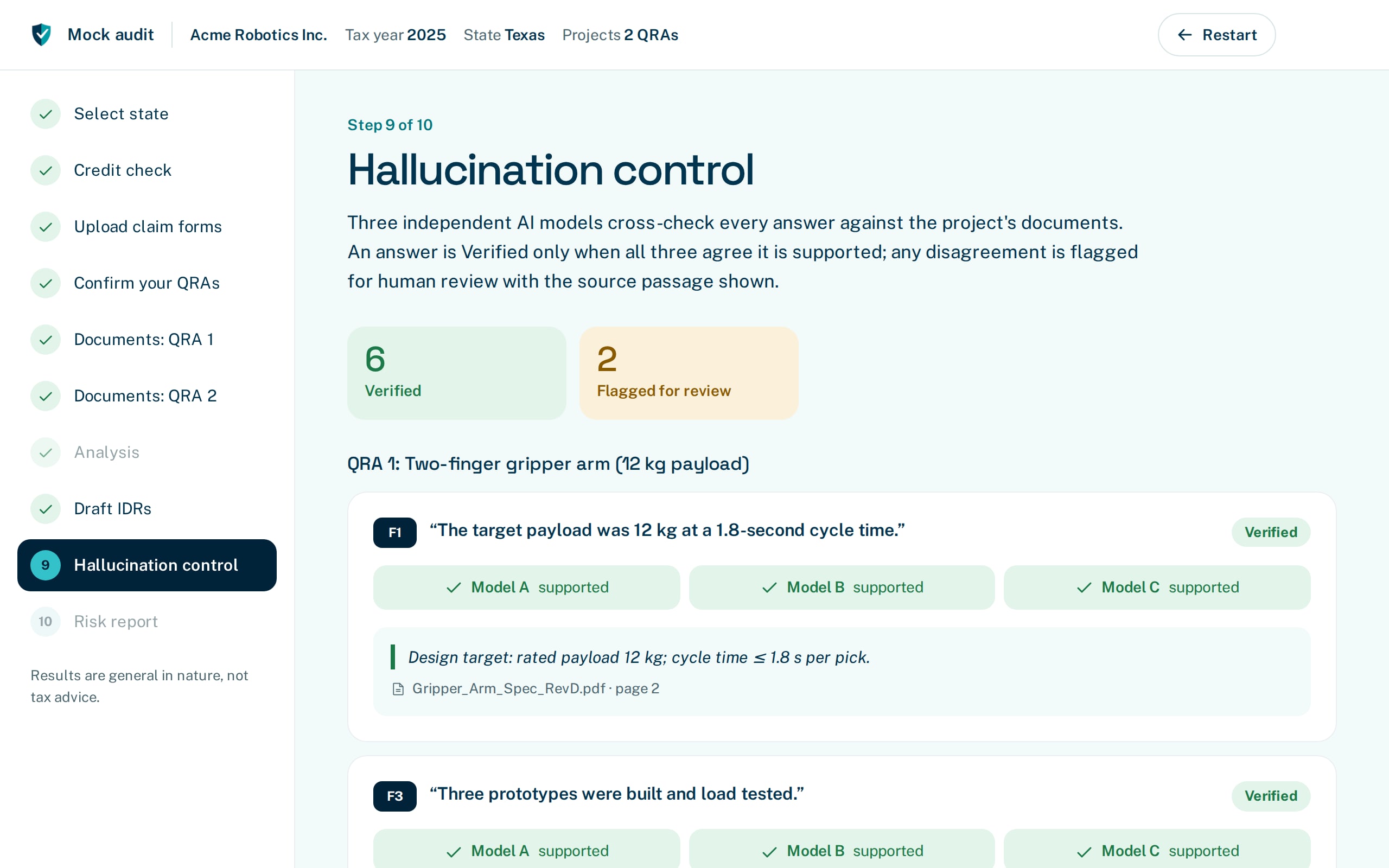
AI cross-check
Multiple AI models cross-check each IDR answer and evidence match against the documents you upload. This reduces, but does not eliminate, the risk of errors, and AI output should be reviewed before you rely on it. An answer is marked "Supported (automated check)" only when all models find it supported by the cited documents; this is not a professional verification of accuracy.
Any disagreement or unsupported statement is flagged for your review, with the source passage shown alongside it. If requested, a person at Swanson Reed can review your mock audit results and re-perform the mock audit for assurance.
Source: rib_layouts_v1-v6.zip · six design files dated Feb–Mar
Source: No test log uploaded; figure appears only in the project description
Source: timesheets_Q1-Q4.csv · project code BRK-25
Risk assessment engine
Federal, state and combined audit-readiness scores from 0 to 100 (a higher score is better), each with a Low, Medium or High risk band. Readiness is broken down across seven areas, and a red flag moves the band to a higher risk level whenever a single issue is serious enough on its own.
federal
state
combined
Red flag: time allocation estimated after year-end (F4, rated Weak)
- Qualification (four-part test)
- 78
- Wage substantiation
- 52
- Contemporaneous documentation and supplies
- 84
- Contract research
- 71
- Calculation and elections
- 80
- State nexus and apportionment
- 61
- State filing and reconciliation
- 88
Fix library
Each gap comes with a specific fix, prioritised by impact and the effort it takes. The projected score shows what the file would look like once the fixes are done, so the work can be planned rather than guessed at.
Combined score
66 → 84
Projected after fixes
- 1Upload vibration test logs for all three prototypesHigh impact · Low effort+9
- 2Add dated notes on the uncertainty from the project kickoffHigh impact · Medium effort+5
- 3Reconcile Texas QREs to the federal QRE total on Form 6765, line 48Medium impact · Low effort+4
Draft examiner responses
A suggested draft reply for each IDR-style question, listing the documents provided in support. Every response must be reviewed for accuracy and completeness by you and your authorized representative before it is submitted. Every draft is marked Review before sending: it is a starting point for your specialist, never a submission.
F3Describe the process of experimentation used to resolve that uncertainty.
The team evaluated alternatives through modelling and physical testing. Six rib geometries were modelled; the three strongest candidates were machined as prototypes and run through vibration testing, with failure points recorded and used to revise the design.
Documents provided
- rib_layouts_v1-v6.zip
- notebook_scan.pdf
- vibration_test_log.xlsx
Risk report export
Export the full risk report as PDF, and each project's IDR-style response as Word, PDF or Google Docs, to share with your CFO, your CPA or your specialist. Every report carries its disclaimer: the analysis is general in nature, not tax advice.
Includes scores, risk by area, the draft IDR, evidence ratings and the fix plan.
Regularly reviewed state rules
State program data is reviewed regularly by tax specialists and updated without waiting for a code release; always confirm current rules with the relevant revenue authority. State program changes that need verification are reviewed internally before they are added to the database.
- Texas: SB 2206 franchise tax credit (8.722%, refundable for no-tax taxpayers) reviewed for reports due on or after January 1, 2026State tax specialist · Oct 2026Published
- Kansas: Transferability guidance updatedState tax specialist · Sep 2026Published
- Michigan: Research and development credit for 2025 expenses reviewed; tentative claims are due to Treasury by March 15 of the following year (April 1, 2026 for 2025 expenses)Internal review · Sep 2026Needs verification
No code release needed: specialists publish rule changes directly.
Shared results
Share the report and exports with your CFO, your CPA firm or your specialist, so everyone works from the same evidence and the same score.
Built on Swanson Reed's R&D practice
creditARMOR and TaxTrex are products of Swanson Reed, a specialist tax advisory practice focused on research and development incentives, working with businesses across multiple jurisdictions.
That relationship gives creditARMOR users access to specialists for technical review, documentation and assistance with existing examinations. If needed, Swanson Reed can assist you with representation before the IRS. Automation organizes the evidence; you and your advisor make the judgments. If requested, a person at Swanson Reed can review your mock audit results and re-perform the mock audit for assurance.
About creditARMOR and Swanson Reed